
Painless Natural Childbirth 2026
Your Comprehensive Guide: Stages, Prices, Comparison with Cesarean, and When to Go to the Hospital

Dr. Mohamed Abdel Fattah El-Senity
Consultant Obstetrics and Gynecology - Ain Shams University
Expert in Painless Natural Childbirth
Last Update: January 2026
Painless natural childbirth is a normal vaginal delivery with the use of epidural anesthesia to relieve pain by 90% while the mother remains fully conscious.
Quick Answers
How much does a painless natural childbirth cost in 2026?
15,000 - 35,000 EGP depending on the hospital.
How long does natural childbirth take?
10-14 hours for the first child, 6-8 hours for the second delivery.
Does an epidural cause paralysis?
No, this is an old myth. Not a single case has been recorded in decades.
When should I go to the hospital?
Contractions every 5 minutes, water breaks, or bleeding.
Table of Contents
- What is natural childbirth?
- Types of natural childbirth
- Painless natural childbirth (Epidural)
- Stages of natural childbirth
- When should you go to the hospital?
- Comparison: Natural vs. Cesarean
- Price of natural childbirth 2026
- Postpartum care
- Potential complications
- Exercises to facilitate childbirth
- Frequently Asked Questions
What is natural childbirth?
Natural childbirth, or vaginal delivery, is the birth of a baby through the vagina after 38 to 41 weeks of pregnancy. It is considered the safest and least expensive method compared to a cesarean section.
Labor: What is it?
Labor is a natural physiological process to expel the fetus, the surrounding membranes, the umbilical cord, and the placenta from the uterus.
Symptoms of early labor:
- Uterine contractions: Regular contractions that increase in intensity over time.
- Loss of the mucus plug: Mucus discharge that may be slightly tinged with blood.
- Lower back pain: Increasing pressure in the back area.
- Water breaking: Rupture of the membranes surrounding the fetus.
- Urge to use the bathroom: Due to the pressure of the baby's head.
Types of natural childbirth
| Type | Description |
|---|---|
| Spontaneous Vaginal Delivery (SVD) | A natural birth without any interventions or medications. |
| Assisted Vaginal Delivery (AVD) | Using assistive tools (vacuum, forceps) or an episiotomy. |
| Induced Vaginal Delivery (IVD) | Stimulating labor with medications when delivery is delayed. |
Painless natural childbirth (Epidural)
Painless childbirth has become the preferred option for many women. It is done via epidural anesthesia, which reduces pain by 90% while the mother remains completely conscious.
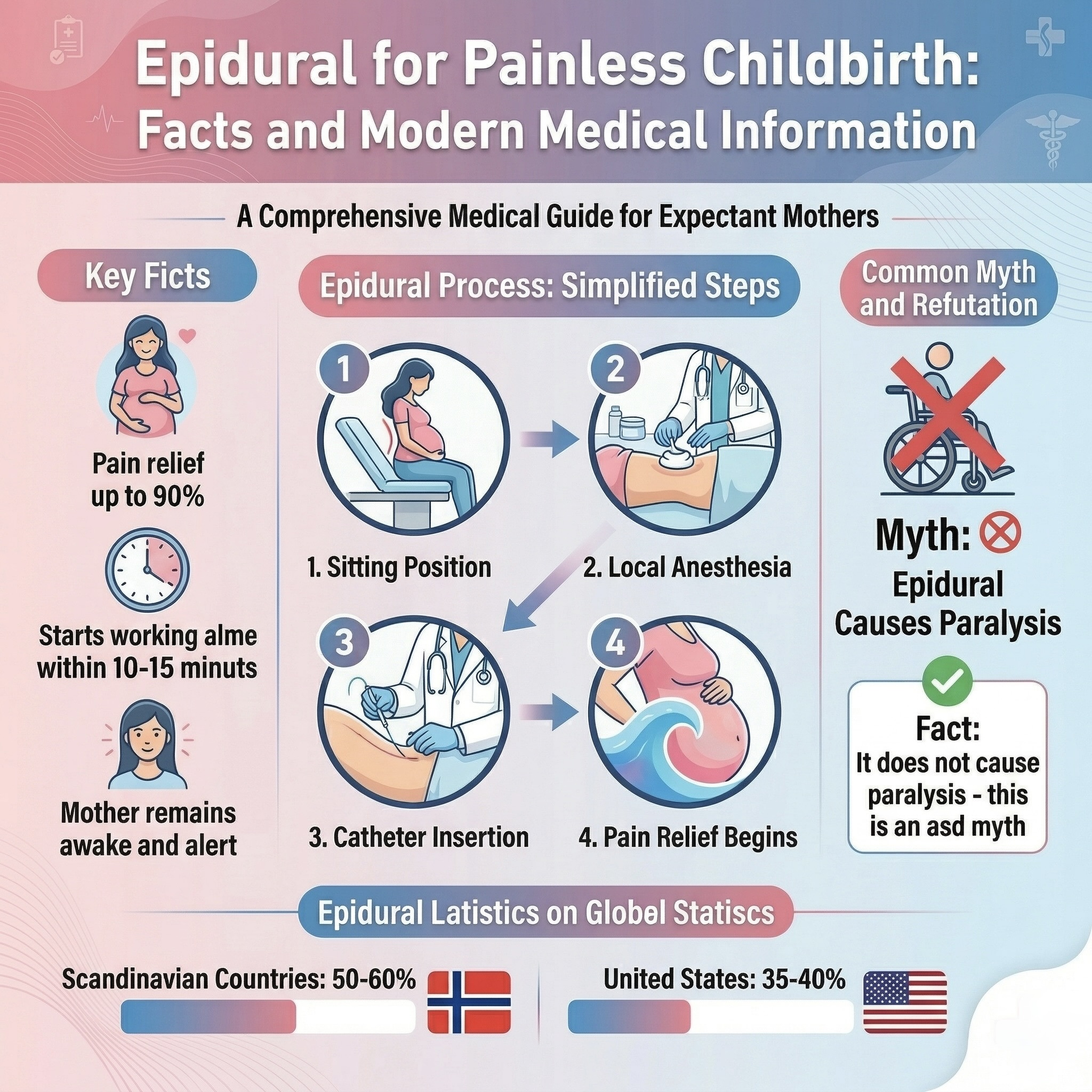
Global Statistics
- 35-40% of births in the United States.
- 50-60% of births in Scandinavian countries.
- 30-40% of births in France.
How is epidural anesthesia administered?
- The mother sits and leans forward slightly.
- The doctor inserts a small needle under local anesthesia.
- A thin tube (catheter) is inserted into the lower part of the spinal cord.
- Anesthetic is delivered through the catheter during labor.
- It takes effect within 10-15 minutes.
Epidural and Paralysis: The Truth
Paralysis from an epidural is an old myth from decades ago when needles were primitive and medications were different. Not a single case of paralysis has been recorded in decades worldwide.
Stages of natural childbirth
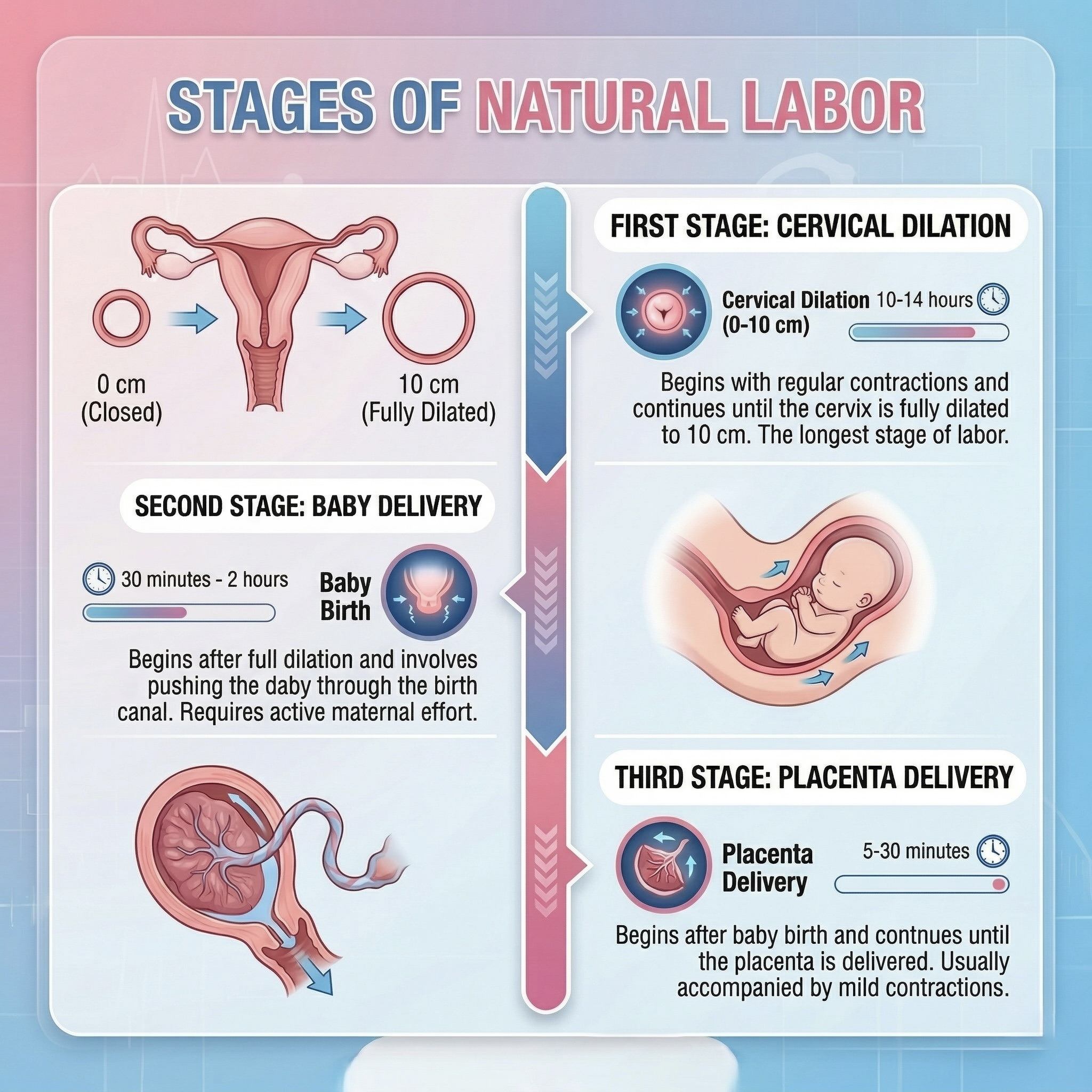
First Stage: Cervical Dilation
Duration: 10-14 hours for the first child, 6-8 hours for the second delivery.
The cervix dilates from 0 to 10 cm to allow the baby to pass.
Second Stage: Delivery of the Baby
Duration: 30 minutes - 2 hours.
Pushing the baby through the birth canal and delivery.
Third Stage: Delivery of the Placenta
Duration: 5-30 minutes.
Separation of the placenta from the uterine wall and its delivery.
When should you go to the hospital?
Go to the hospital immediately if:
- Regular contractions every 5 minutes for an hour.
- Water breaks (clear or pink).
- Vaginal bleeding.
- Decreased fetal movement.
- Severe continuous pain.
Difference between true and false labor:
| True Labor | False Labor |
|---|---|
| Regular increasing contractions | Irregular contractions |
| Pain increases over time | Pain is constant or disappears |
| Does not stop with movement | Stops with walking or resting |
| Accompanied by cervical dilation | No dilation |
Comparison: Natural vs. Cesarean
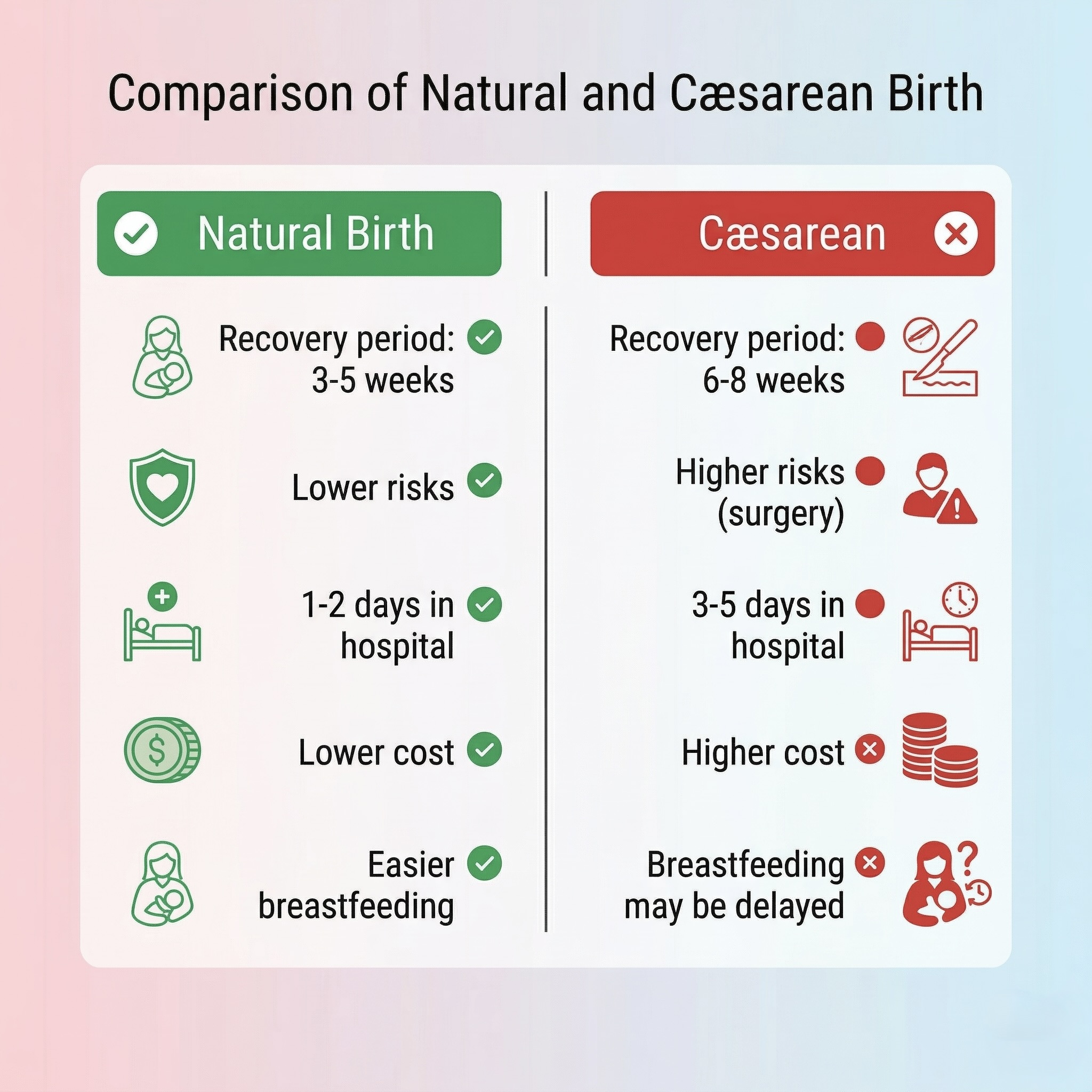
| Comparison | Natural Childbirth | Cesarean Section |
|---|---|---|
| Recovery time | 3-5 weeks | 6-8 weeks |
| Risks | Lower | Higher (major surgery) |
| Hospital stay | 1-2 days | 3-5 days |
| Cost | Lower | Higher |
| Breastfeeding | Easier initially | May be delayed |
| Future pregnancies | No restrictions | May require a C-section |
Price of Painless Natural Childbirth 2026
| Type of Delivery | Approximate Price |
|---|---|
| Regular Natural Childbirth | 8,000 - 15,000 EGP |
| Painless Natural Childbirth (Epidural) | 15,000 - 35,000 EGP |
| Cesarean Section | 25,000 - 50,000 EGP |
Notes on Prices
- Prices vary by hospital and doctor.
- May or may not include: mother's stay, nursery, medical tests.
- Ask about comprehensive packages.
Postpartum Care
Top tips for a fast recovery:
- Perineal care: Ice packs for the first 24 hours, antiseptic vaginal wash.
- Take painkillers: As prescribed by the doctor (safe with breastfeeding).
- Avoid constipation: High-fiber foods, 8 glasses of water daily.
- Kegel exercises: To strengthen vaginal muscles (20 times × 3 sets).
- Continuous movement: Light walking to stimulate blood circulation.
- Change sanitary pads: Regularly to prevent infection.
- Visit the doctor: To ensure proper wound healing.
Wound Healing Time
- Without tearing: 3-5 weeks
- With episiotomy: 6 weeks
Potential Complications
Although natural childbirth is safer, some complications may occur:
- Tissue tearing: May require surgical stitches.
- Excessive bleeding: If the uterus fails to contract to expel the placenta.
- Temporary urinary incontinence: Improves with Kegel exercises.
- Uterine prolapse: Rare, typically with repeated deliveries.
Consult a doctor immediately if you experience:
- Fever (temperature above 38°C).
- Severe bleeding (more than one sanitary pad per hour).
- Foul-smelling discharge.
- Severe abdominal pain.
Exercises to Facilitate Childbirth
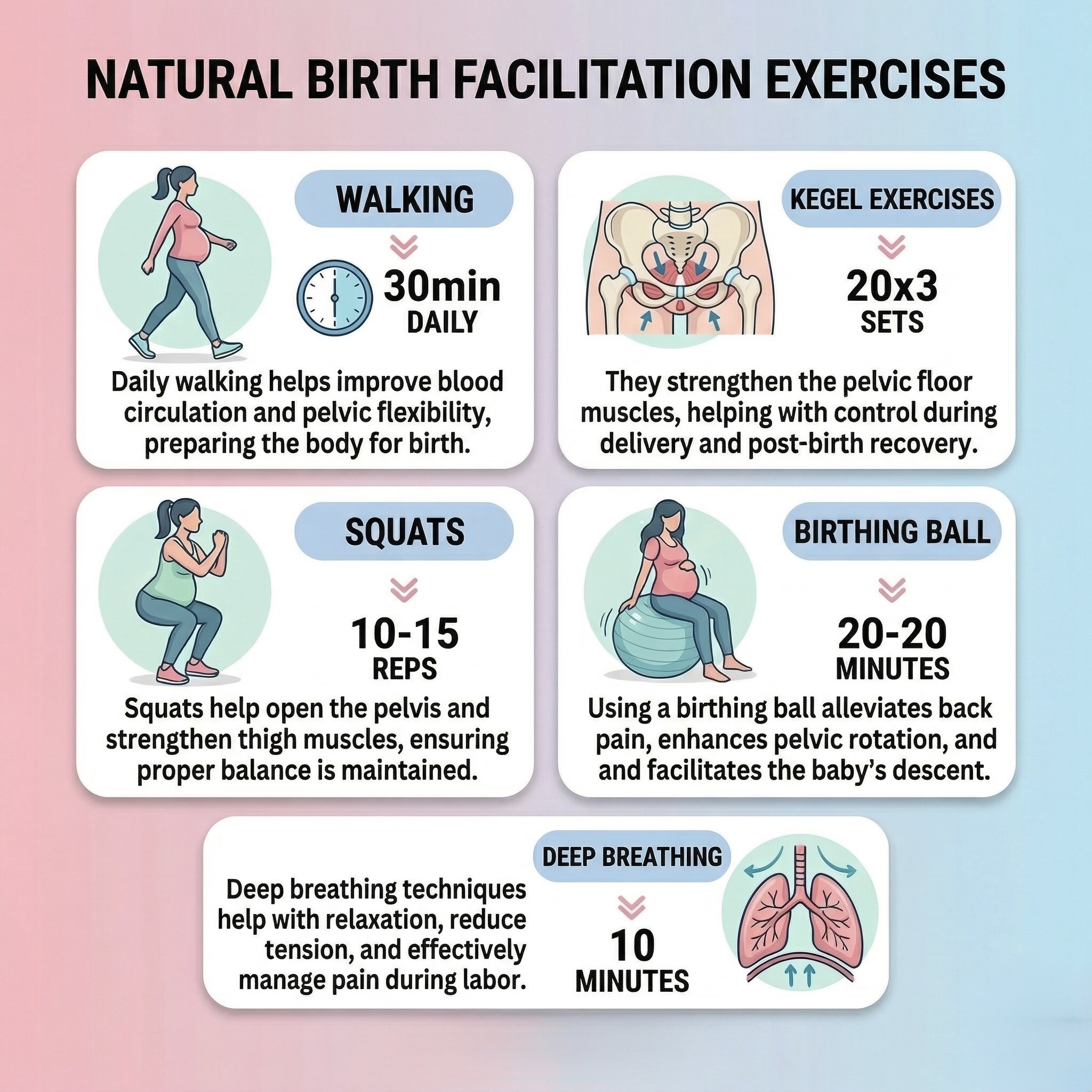
Exercising during pregnancy helps strengthen pelvic muscles and facilitate the delivery process. Start in your seventh month after consulting your doctor.
Daily Walking
Duration: 30 minutes daily.
Helps the baby's head to drop and stimulates natural labor.
Kegel Exercises
Repetitions: 20 times × 3 sets daily.
Contract your vaginal muscles for 3 seconds, then relax. Strengthens pelvic muscles and prevents urinary incontinence.
Squats
Repetitions: 10-15 times × 2 sets.
Widens the pelvis and helps the baby get into the correct position.
Birth Ball Exercises
Duration: 15-20 minutes.
Sitting and swaying on the ball relieves back pain and opens the pelvis.
Deep Breathing Exercises
Repetitions: 5-10 minutes daily.
Helps with relaxation and pain management during labor.
Important Warning
Stop exercising immediately and consult your doctor in case of: bleeding, severe pain, dizziness, or shortness of breath.
Related Articles
Scientific Sources
Frequently Asked Questions
Important Medical Notice
The information in this article is for educational purposes only and does not substitute for a doctor's consultation. Do not make medical decisions without medical supervision. Every pregnancy is different and requires individual evaluation.
Book Your Appointment Now with Dr. Mohamed El-Senity
Specialized consultation for pregnancy care and painless natural childbirth