

Dr. Mohamed Abdel Fattah El-Senity
Consultant in Gynecological Endoscopic SurgeriesHysterectomy: The Comprehensive Guide to Types, Techniques, and Recovery 2026
A comprehensive medical guide answering all your questions about hysterectomy, from preparation to full recovery
⚠️ Important Medical Warning
The information provided is for educational purposes only. Go to the emergency room immediately if you notice:
- Heavy vaginal bleeding (more than one pad per hour)
- Fever higher than 38.5°C
- Severe pain that does not respond to painkillers
- Redness or discharge from the wound
Definition
Hysterectomy is a surgical procedure to partially or completely remove the uterus, and is performed to treat conditions such as fibroids, endometriosis, severe bleeding, or cancer. The surgery takes 1-3 hours depending on the technique used, with a success rate exceeding 97%.
Key Takeaways
- Procedure duration: 1-3 hours depending on the technique
- Success rate: Exceeds 97% with rare complications
- Best technique: Laparoscopy for most cases (faster recovery)
- Recovery period: 2-4 weeks (laparoscopic) / 6-8 weeks (open)
- Cost in Egypt: 25,000-60,000 EGP depending on technique
- Pregnancy: Not possible after removal (final decision)
- Marital relations: Resumed after 6-8 weeks with doctor's approval
Table of Contents
What is a hysterectomy?
Hysterectomy is a surgical procedure in which the uterus - the organ where a fetus grows during pregnancy - is removed. It is one of the most common gynecological surgeries worldwide, performed to treat a variety of medical conditions.
Medical Information
According to the American College of Obstetricians and Gynecologists (ACOG), minimally invasive approaches such as laparoscopic or vaginal surgery are preferred whenever possible, because they provide a shorter recovery period and fewer complications.
The type of removal and the technique used depend on several factors, including: the reason for the surgery, the size of the uterus, the patient's medical history, and the surgeon's expertise. Therefore, it is essential to discuss all options with your specialized doctor.
Watch the Explanatory Video
Types of Hysterectomy
Definition: There are 4 main types of hysterectomy: (1) Total hysterectomy - removing the uterus and cervix, (2) Partial hysterectomy - uterus only while preserving the cervix, (3) Radical hysterectomy - including surrounding tissues, (4) With oophorectomy - for cancer cases.
The types of hysterectomy differ based on the parts being removed:
| Type | What is Removed | Common Use |
|---|---|---|
| Total Hysterectomy | Uterus + Cervix | Fibroids, Cancer |
| Partial (Supracervical) | Uterus only (preserving the cervix) | Certain fibroid cases |
| Radical Hysterectomy | Uterus + Cervix + Surrounding tissues | Cervical cancer |
| With Oophorectomy | Uterus + Ovaries + Fallopian tubes | Ovarian cancer, Hereditary cases |
Read also: Duration of Hysterectomy Surgery
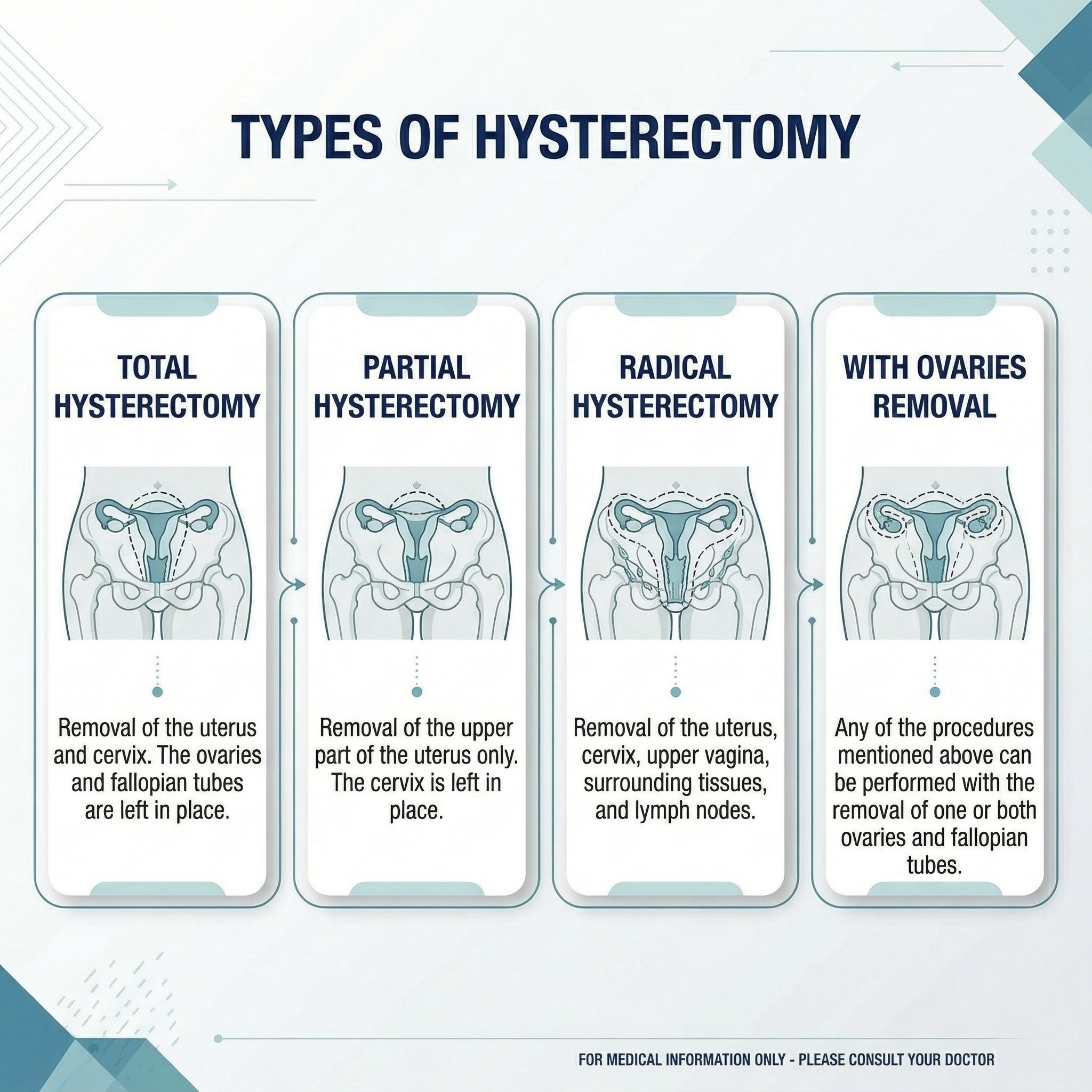
Infographic: Types of Hysterectomy
Surgical Techniques
Definition: Laparoscopy is the preferred technique for most cases (2-4 weeks recovery, 1-2 days stay). Vaginal surgery is for uterine prolapse. Open abdominal surgery is for large tumors (6-8 weeks recovery).
Several techniques are available for performing a hysterectomy, each with its own advantages:
| Technique | Duration | Hospital Stay | Recovery | Best For |
|---|---|---|---|---|
| Laparoscopic | 1-2 hours | 1-2 days | 2-4 weeks | Most cases |
| Vaginal | 1-2 hours | 1-2 days | 3-4 weeks | Uterine prolapse |
| Open Abdominal | 1-3 hours | 3-5 days | 6-8 weeks | Large tumors |
| Robotic | 1-2 hours | 1 day | 2-3 weeks | Complex cases |
Why is Laparoscopy Preferred?
Studies from 2024-2025 indicate that laparoscopic surgery is superior to open surgery in: reducing blood loss, a shorter hospital stay, and a faster recovery. Dr. Mohamed Abdel Fattah is a pioneer in this technique and performed the first robotic surgery in the Middle East.
Read also: My Experience with Laparoscopy 2024
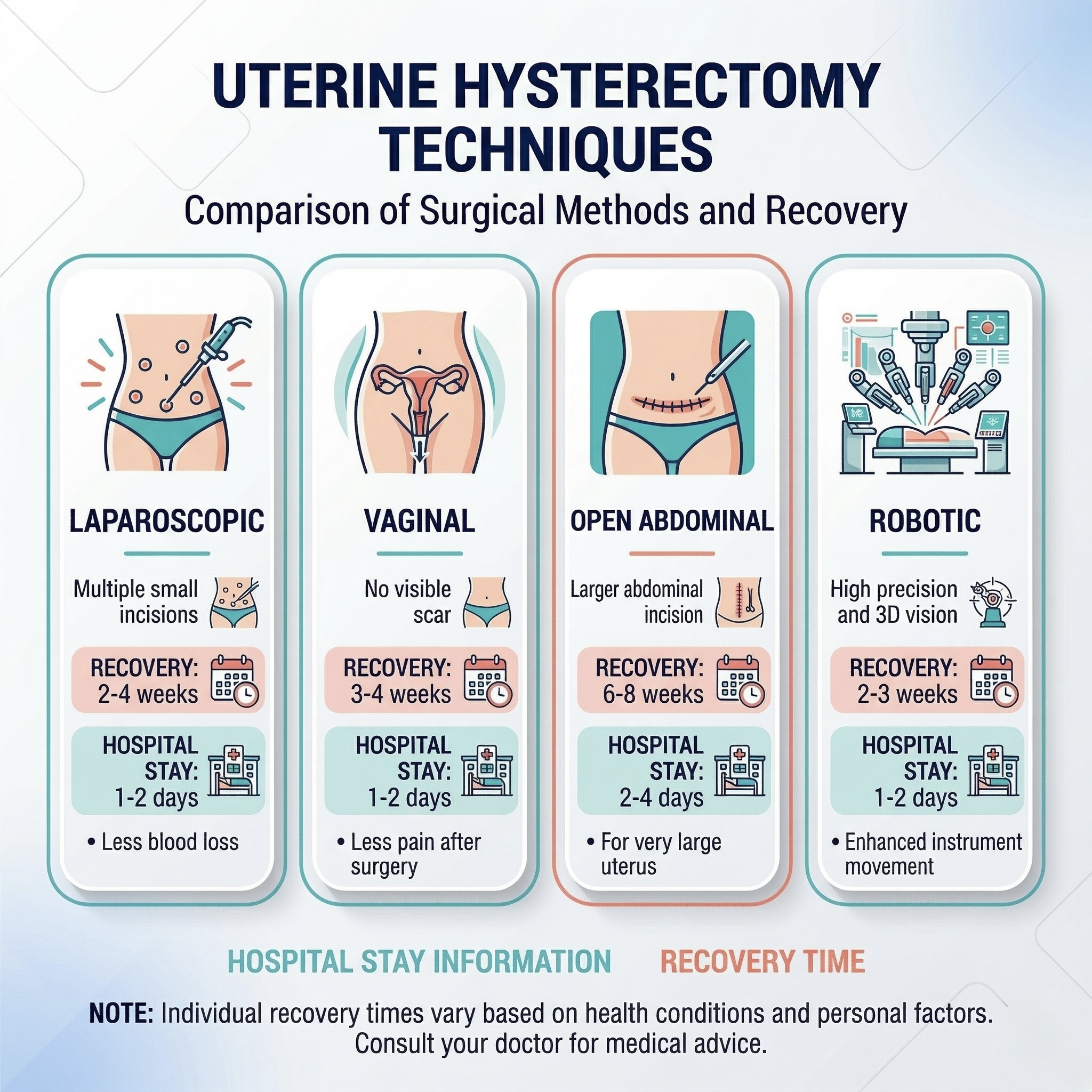
Infographic: Comparison of Hysterectomy Techniques
Indications for Surgery
Definition: The top 5 indications for hysterectomy: (1) Large fibroids, (2) Endometriosis, (3) Severe uterine bleeding, (4) Uterine prolapse, (5) Gynecological cancers. The surgery is usually performed after other treatments have failed.
The doctor may recommend a hysterectomy in the following cases:
1. Uterine Fibroids
Benign tumors that cause heavy bleeding and pain. It is the most common reason for a hysterectomy.
2. Endometriosis
Growth of the uterine lining tissue outside the uterus, causing chronic pain and fertility issues.
3. Abnormal Uterine Bleeding
When other treatments fail to control severe or prolonged bleeding.
4. Uterine Prolapse
The uterus slipping into the vaginal canal due to weak supporting ligaments.
5. Gynecological Cancers
Cancer of the uterus, cervix, or ovaries may necessitate removal as part of the treatment.
Read also: Treatment of Fibroids in the Uterus
Therapeutic Alternatives Before Hysterectomy
Definition: Before resorting to a hysterectomy, there are 6 therapeutic alternatives to try: Hormonal therapy, Hormonal IUD (Mirena), Myomectomy (removing only the fibroid), Uterine artery embolization, Endometrial thermal ablation, and medications. The choice depends on the diagnosis and your desire to have children.
A hysterectomy is a final decision, so it's important to know the available alternatives:
| Alternative | Suitable For | Preserves Fertility |
|---|---|---|
| Myomectomy (Fibroid Removal Only) | Uterine fibroids | ✅ Yes |
| Uterine Artery Embolization | Fibroids, Bleeding | ⚠️ Possible |
| Hormonal IUD (Mirena) | Severe bleeding | ✅ Yes |
| Hormonal Therapy | Endometriosis | ✅ Yes |
| Endometrial Thermal Ablation | Irregular bleeding | ❌ No |
💡 Important Tip
If you wish to have children in the future, discuss all available alternatives with your doctor before making a decision for a hysterectomy. Dr. Mohamed Abdel Fattah specializes in laparoscopic fibroid removal while preserving the uterus.
Preparation Before Surgery
Definition: Preparation includes: Comprehensive blood tests, ultrasound, fasting 8 hours before surgery, stopping aspirin a week prior, and packing a hospital bag. You will need a companion to return home.
📋 A week before surgery:
- Required tests: Comprehensive blood test, kidney and liver functions, blood clotting, heart ECG.
- Stopping medications: Aspirin and blood thinners (after consulting the doctor).
- Arranging your home: Prepare your bedroom, put things within easy reach.
- Arranging help: Ensure someone is there to help you for the first two weeks.
🎒 What to pack for the hospital:
- Loose and comfortable clothes to wear upon discharge.
- Comfortable, non-slip slippers.
- Personal hygiene items.
- Large sanitary pads.
- Phone and charger.
- A book or device for entertainment.
⏰ Day of surgery:
- Fasting: At least 8 hours (no food or drink).
- Showering: Use antibacterial soap.
- Do not wear: Makeup, nail polish, jewelry.
- Arrival: At least an hour before the appointment.
When to Call the Doctor Immediately?
Definition: Call immediately if you notice: Fever higher than 38°C, heavy vaginal bleeding, severe pain unresponsive to painkillers, redness or pus from the wound, difficulty urinating, or leg pain (a sign of a potential clot).
🚨 Emergency Signs:
- High fever: Above 38.5°C.
- Heavy bleeding: Changing a pad every hour or less.
- Severe pain: Does not improve with prescribed painkillers.
- Breathing problems: Sudden shortness of breath.
- Signs of a clot: Swelling or pain in the leg.
- Discharge from the wound: Pus or a foul odor.
- Inability to urinate: For more than 8 hours.
- Continuous vomiting: Does not stop.
📞 Emergency Numbers:
Save these numbers in your phone:
- Heliopolis Clinic: 01200520520
- Fifth Settlement Clinic: 01204060404
Psychological Impact and Coping
Definition: It is normal to feel a mix of emotions after the surgery: relief from the end of pain, and perhaps sadness over the loss of the ability to have children. Most women adjust within 3-6 months. Do not hesitate to seek psychological support.
😔 Normal feelings you may experience:
- Relief: From the end of chronic pain and bleeding.
- Sadness: Over the loss of the ability to have children (even if you did not want to).
- Feeling incomplete: Some women feel a change in their female identity.
- Mood swings: Especially if the ovaries were removed (due to hormonal changes).
💪 How to deal with these feelings:
- Talk about your feelings: With your husband, a close friend, or a therapist.
- Do not compare yourself: Every woman adjusts in her own way and at her own pace.
- Focus on the positives: Getting rid of pain, a better quality of life.
- Seek help: There is no shame in consulting a therapist.
- Take care of yourself: Light exercise, good nutrition, enough sleep.
A Reassuring Message
The uterus is an organ, not an identity. You are the same strong woman before and after the surgery. Thousands of women live full, happy lives after a hysterectomy. If you feel sad, this is normal - but if it persists for more than two months, consult a specialist.
Marital Life After Surgery
Definition: Marital relations can be resumed after 6-8 weeks (with the doctor's approval). Studies show that most women do not experience a negative impact on their marital life; it may actually improve due to the end of pain and bleeding. Sensation and desire are unaffected unless the ovaries are removed.
When can relations be resumed?
- Time required: 6-8 weeks after surgery.
- Condition: Following the doctor's approval during a follow-up visit.
- Reason: To give the body time to heal internally.
❓ Frequently Asked Questions:
Will I feel a difference?
Most women do not notice a difference. The sensation in the sensitive area (clitoris) is not affected because it is not in the uterus.
Will my desire be affected?
If the ovaries are preserved: hormones and desire are not affected. If the ovaries are removed: desire may decrease, which can be treated with hormone replacement therapy.
Will my husband feel a difference?
In most cases, no, especially with laparoscopic surgery. A slight difference (if any) disappears over time.
Tips for a gradual return:
- Start slowly and gradually.
- Use a lubricant if you experience dryness.
- Communicate openly with your husband about your feelings.
- Choose comfortable positions initially.
- Stop immediately if you feel pain.
Recovery After Surgery
Definition: Most women return to light activities within 2-4 weeks (laparoscopy), and to full normal life within 6-8 weeks. Open surgery requires more time (8-12 weeks).
The recovery period varies depending on the type of surgery used. Here is the expected recovery timeline:
| Stage | Laparoscopic/Vaginal | Open Abdominal |
|---|---|---|
| Hospital Discharge | 1-2 days | 3-5 days |
| Light Walking | Next day | 2-3 days |
| Return to Desk Work | 2-3 weeks | 4-6 weeks |
| Full Activity | 4-6 weeks | 8-12 weeks |
Tips for a Fast Recovery
- Adequate rest: Listen to your body and do not overexert yourself.
- Light walking: Helps prevent clots and improves blood circulation.
- Avoid heavy lifting: For at least 6 weeks.
- Balanced diet: Rich in fiber to prevent constipation.
- Drink fluids: 8 glasses of water daily.
- Avoid marital relations: 6-8 weeks until permitted by the doctor.
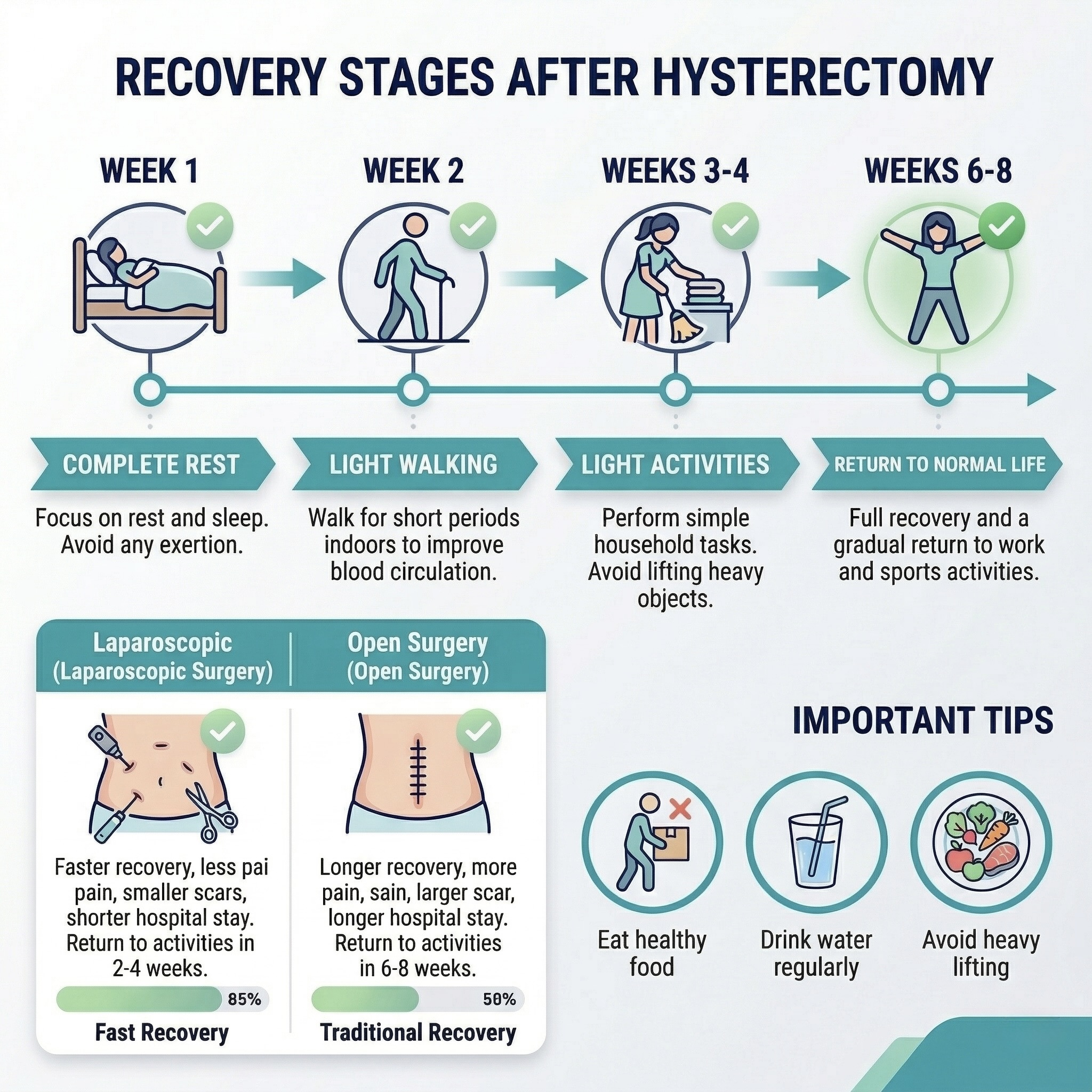
Infographic: Recovery Stages After Hysterectomy
Do you have questions about your condition?
Dr. Mohamed Abdel Fattah El-Senity specializes in Gynecological Endoscopic Surgeries with over 15 years of experience.
Cost of Surgery in Egypt 2026
Definition: The cost of a hysterectomy in Egypt ranges between 25,000-60,000 EGP. Laparoscopic (35-60K), Vaginal (30-50K), Open Abdominal (25-40K). It depends on the technique and the hospital.
The cost of a hysterectomy varies based on several factors:
| Type of Surgery | Approximate Cost |
|---|---|
| Laparoscopic Hysterectomy | 35,000 - 60,000 EGP |
| Vaginal Hysterectomy | 30,000 - 50,000 EGP |
| Open Abdominal Hysterectomy | 25,000 - 40,000 EGP |
Factors Influencing the Cost:
- Type of technique used.
- Level of the hospital and room tier.
- Required length of stay.
- Required tests and investigations.
- Surgeon's expertise.
Frequently Asked Questions
It takes 1-3 hours depending on the technique: Laparoscopic (1-2 hours), Vaginal (1-2 hours), Open Abdominal (1-3 hours). Factors such as uterus size and the presence of adhesions affect the duration.
It is generally considered safe with a success rate exceeding 97%. Complications are rare and include: bleeding (2-3%), infection (1-2%), and injury to adjacent organs (less than 1%). Choosing a specialized surgeon minimizes risks.
No, pregnancy is not possible after a hysterectomy because the uterus is the organ where the fetus grows. Therefore, this decision is final and should be carefully discussed with your doctor.
Most women do not experience a negative impact on their marital life; it may actually improve due to the end of pain and bleeding. It is recommended to wait 6-8 weeks before resuming relations.
Alternatives include: removing only the fibroid (myomectomy), uterine artery embolization, hormone therapy, and hormonal IUDs (Mirena). The choice depends on the diagnosis and the patient's desire to have children.
Your menstrual cycle will not return after a hysterectomy. If the ovaries are preserved, hormones will continue naturally until natural menopause.
It is performed under general anesthesia, so you will not feel any pain during the surgery. Afterward, you may feel mild pain that can be managed with prescribed painkillers.
Laparoscopy: small incisions, 1-2 days stay, 2-4 weeks recovery, less pain. Open surgery: large incision, 3-5 days stay, 6-8 weeks recovery. Laparoscopy is preferred for most cases.
Why Dr. Mohamed Abdel Fattah El-Senity?
Dr. Mohamed Abdel Fattah El-Senity
Expert in Gynecological Endoscopic Surgeries
Academic and Professional Journey:
- Bachelor of Medicine and Surgery with Honors - 2003
- Master of Obstetrics and Gynecology - Faculty of Medicine, Ain Shams University with Honors - 2008
- Member of the Royal College of Surgeons - England - 2012
- European Fellowship in Gynecological Endoscopy
- MD in Obstetrics and Gynecology with Honors
Current Positions:
- Consultant of Obstetrics and Gynecology Surgeries at Ain Shams University Hospitals
- Assistant Professor of Obstetrics and Gynecology at Faculty of Medicine, Ain Shams University
- Director of Obstetrics and Gynecology Unit at Dar El Shifa Hospital
🏆 Outstanding Expertise
Dr. Mohamed Abdel Fattah has contributed to numerous local and international conferences on obstetrics, gynecology, and endoscopic surgeries, and is considered one of the pioneers in the field of gynecological endoscopic surgeries in Egypt and the Middle East.
Why choose him for your surgery?
- Academic and practical experience: Over 20 years in the field.
- International training: Fellowships and memberships from England and Europe.
- Sub-specialty: Specialized in minimally invasive endoscopic surgeries.
- Academic reputation: Professor at the Faculty of Medicine, Ain Shams University.
- Comprehensive follow-up: Integrated medical care before and after the surgery.
Book Your Consultation Now
Comprehensive assessment of your condition and explanation of all available treatment options
Related Articles
⚕️ Medical Disclaimer
The information provided in this article is for educational and awareness purposes only and does not substitute direct medical consultation with a specialized doctor. Every medical condition is unique and requires personal evaluation. Do not make any medical decision based solely on this information without consulting your doctor. In case of an emergency, go immediately to the nearest hospital.
Medical Reviewer: Dr. Mohamed Abdel Fattah El-Senity - Consultant Obstetrics and Gynecology Surgeries
Date Published: January 2026 | Last Review: January 2026